
The only thing technology can’t take from your business is how people think of you.
This is my last dispatch from Dallas and HighLevel’s Level Up 2026. On Day 1, I wrote about getting found in AI search. On Day 2, it was earning attention and trust. Day 3 closed with Gary Vaynerchuk, and he tied the whole week together with one word: brand.
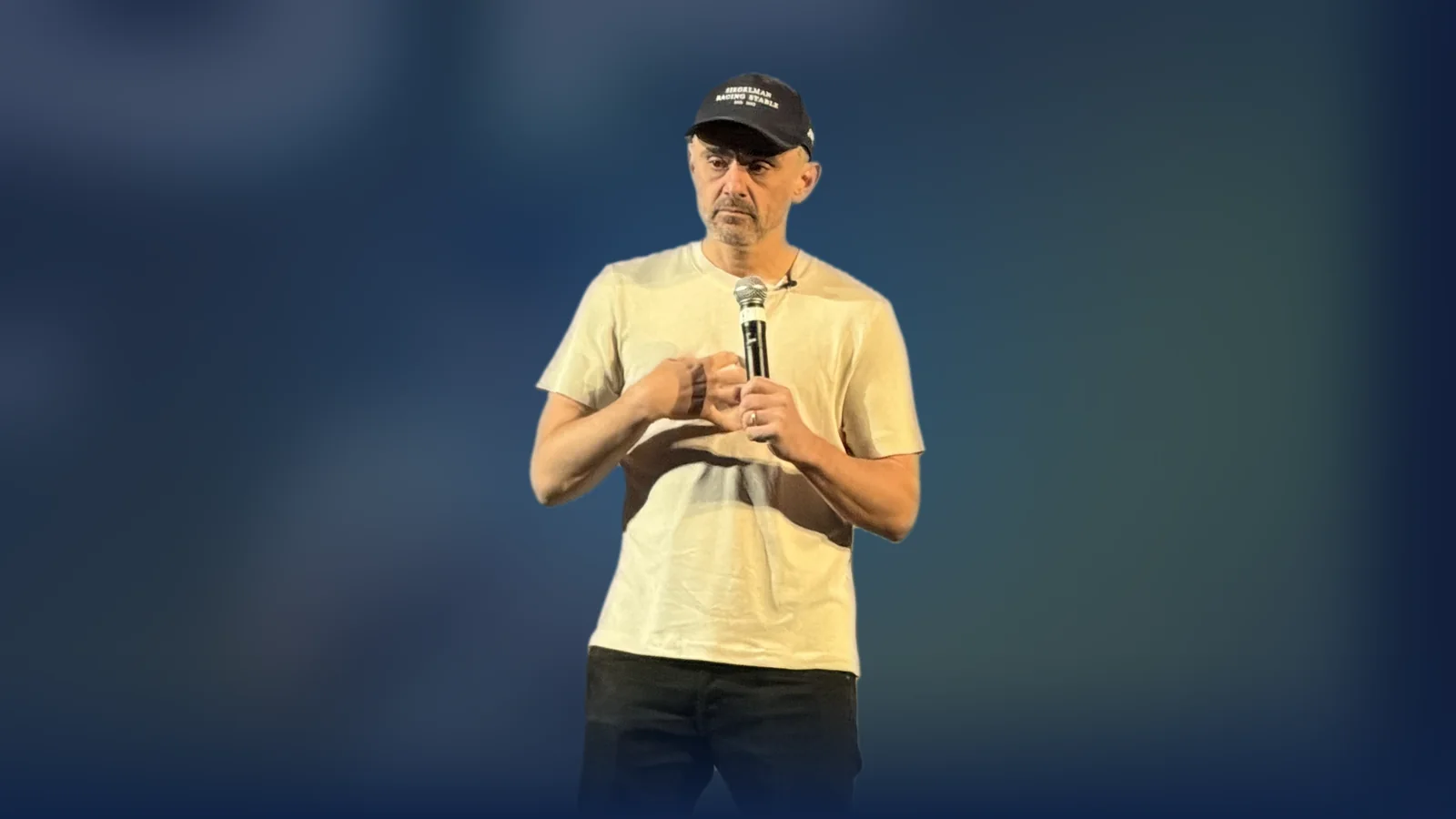
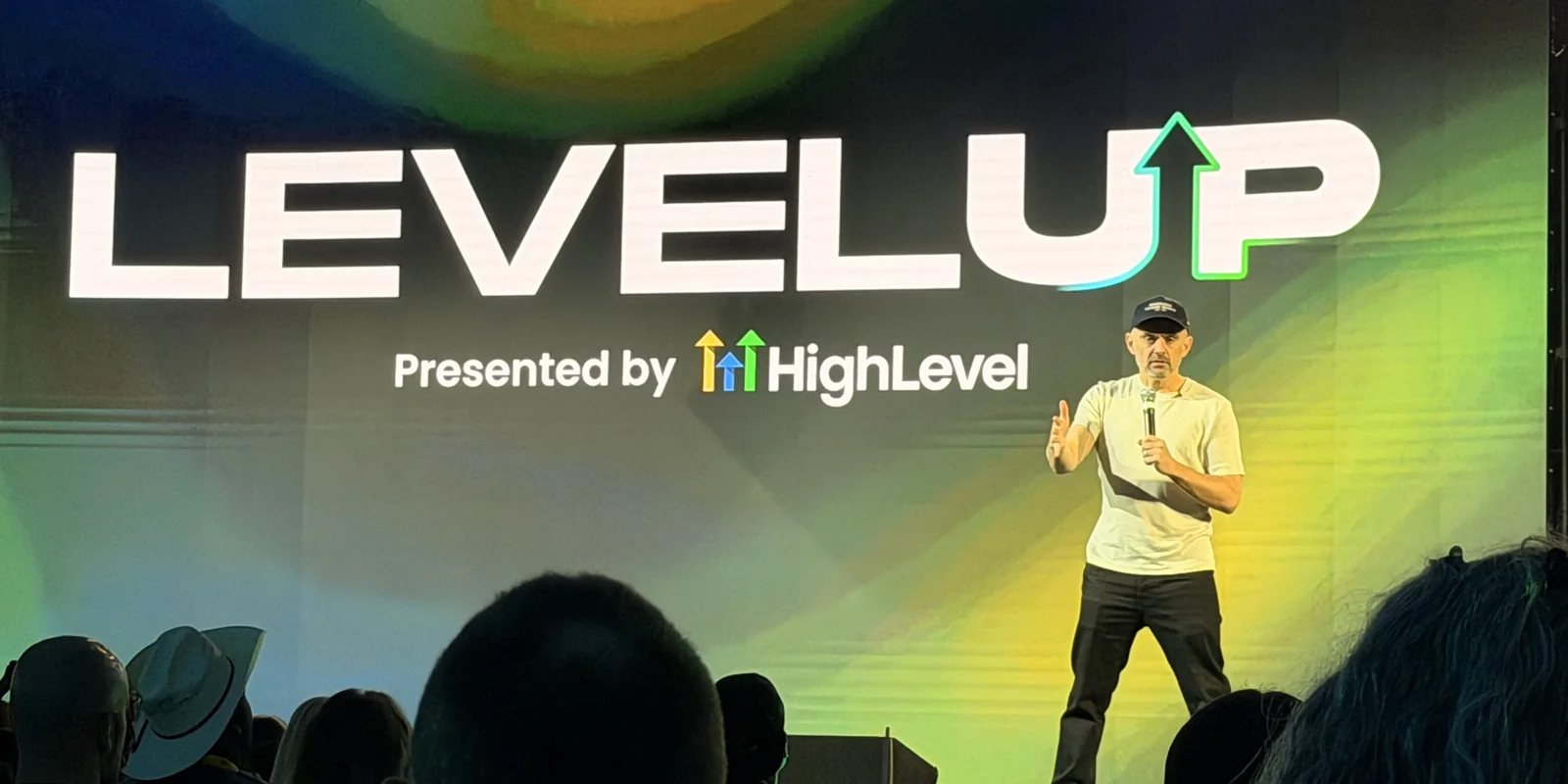
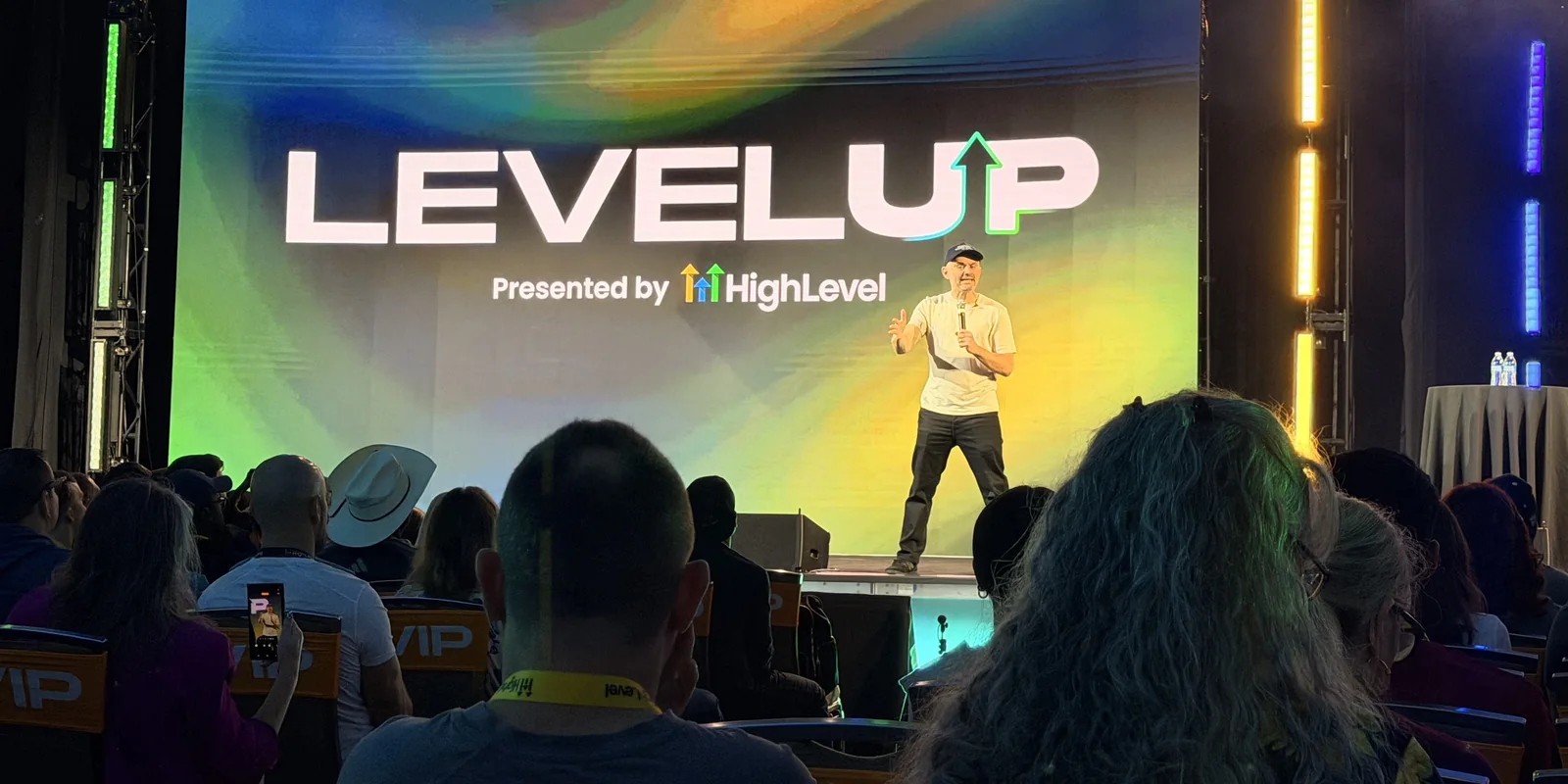
Gary didn’t use slides. He walked the stage with a mic and talked, so the graphics in this post are ours, built from what he said. Here is what I’m taking home, and what it means for your customers.
- Brand is the moat. Your reputation, how people think of you and whether people even know who you are is what protects you when technology comes for your industry.
- Volume wins attention, and it’s getting cheaper. Showing up everywhere used to take a big team. With AI tools, it doesn’t.
- Free reach won’t last forever. You can still reach people on social media without paying for every view. Use it while it’s here.
Brand is the moat
He opened with a story. Years ago, right after investing early in Uber, he gave a keynote to the National Taxi and Limousine Association and warned the room that this new thing was going to change their business. The first person at the microphone told him he was naive. The medallion owners had been doing business for decades and felt safe. You know how that story ends.
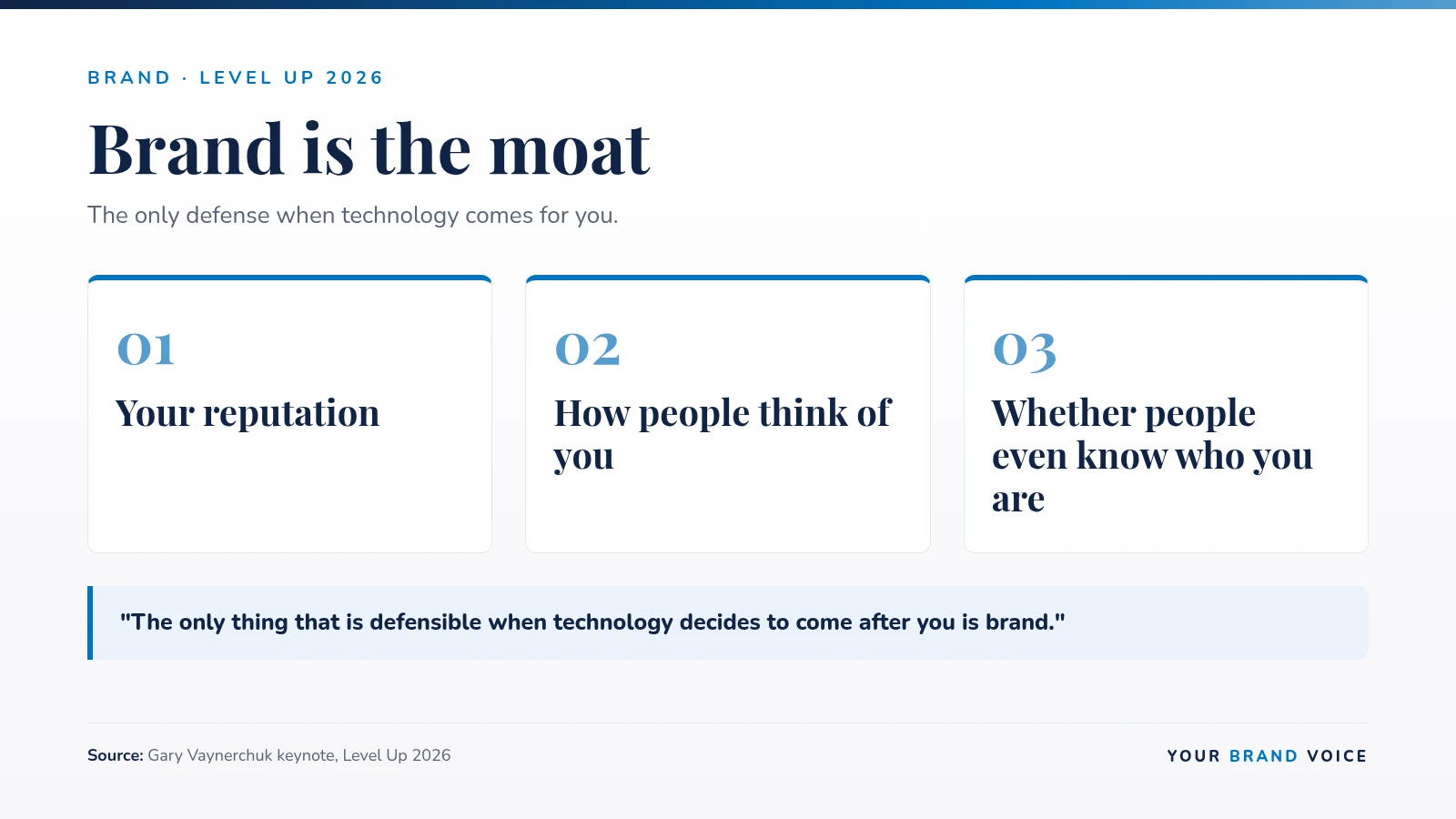
His point was that a license, a contract or a good location won’t protect you when technology comes for your industry. In his words, “the only thing that is defensible when technology decides to come after you is brand.” Then Gary put it more simply:
“Brand is the moat.”
He defined brand as three things: your reputation, how people think of you, and whether people even know who you are.
For a plumber, a dental office or a neighborhood restaurant, that is the whole game. When an assistant picks three businesses to call, or a neighbor asks who to use, the business people already know and trust is the one that gets the call.
Volume is the price of attention
He didn’t sugarcoat this one: “volume of output is a requirement to compete in the competition for attention.” Then he shared his own numbers. He is on ten platforms with about a hundred handles, posting six to nine hundred pieces of content a day with a thirty-person internal team. His goal is ten thousand pieces a day in the second quarter of 2027.
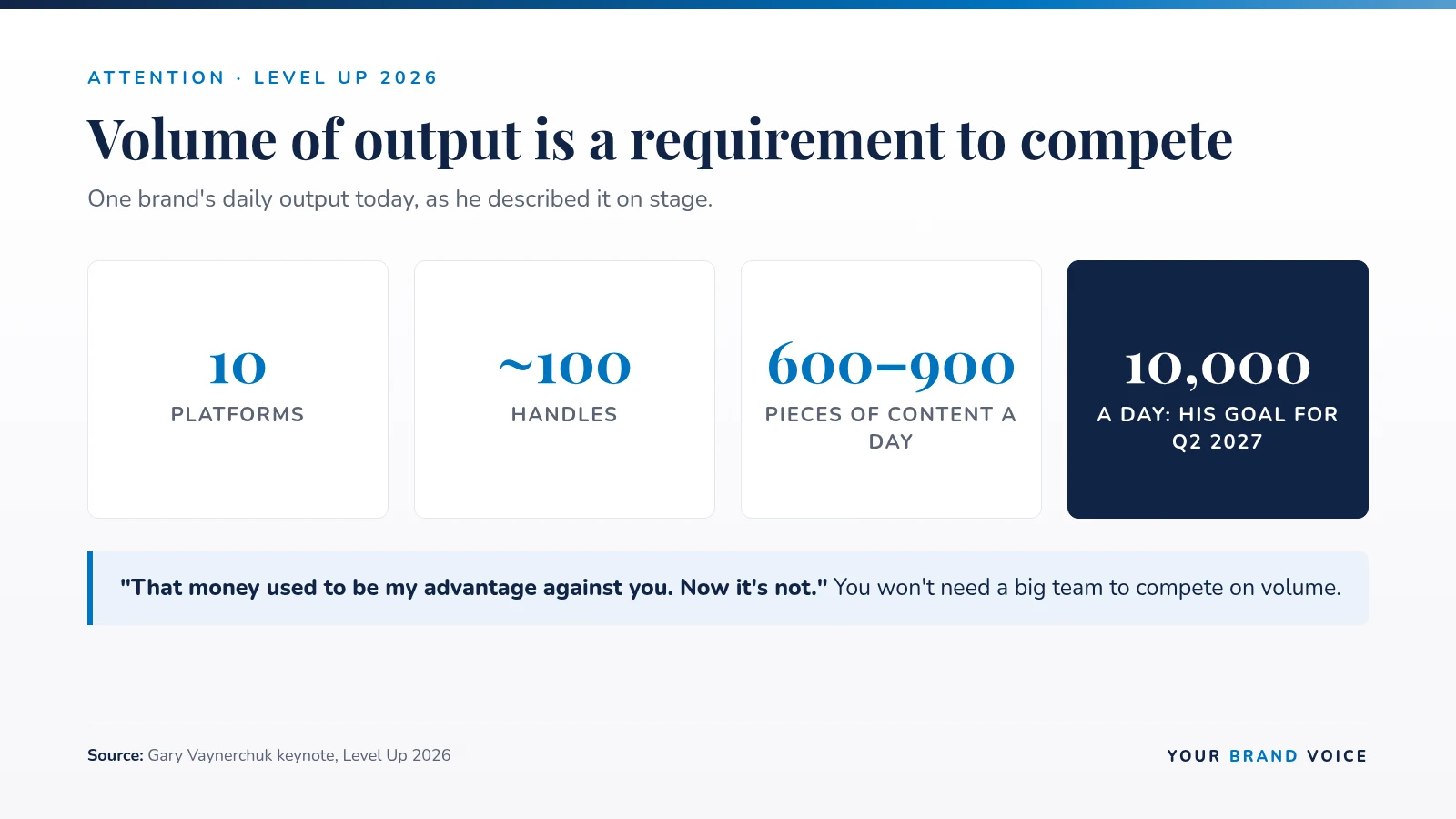
Then came the part that matters for every small business owner in the room. He said his content team costs him six million dollars, and that the advantage is disappearing: “That money used to be my advantage against you. Now it’s not.” You won’t need a big team to show up often. You need a plan, a steady rhythm and the right tools.
Start with what you’re good at
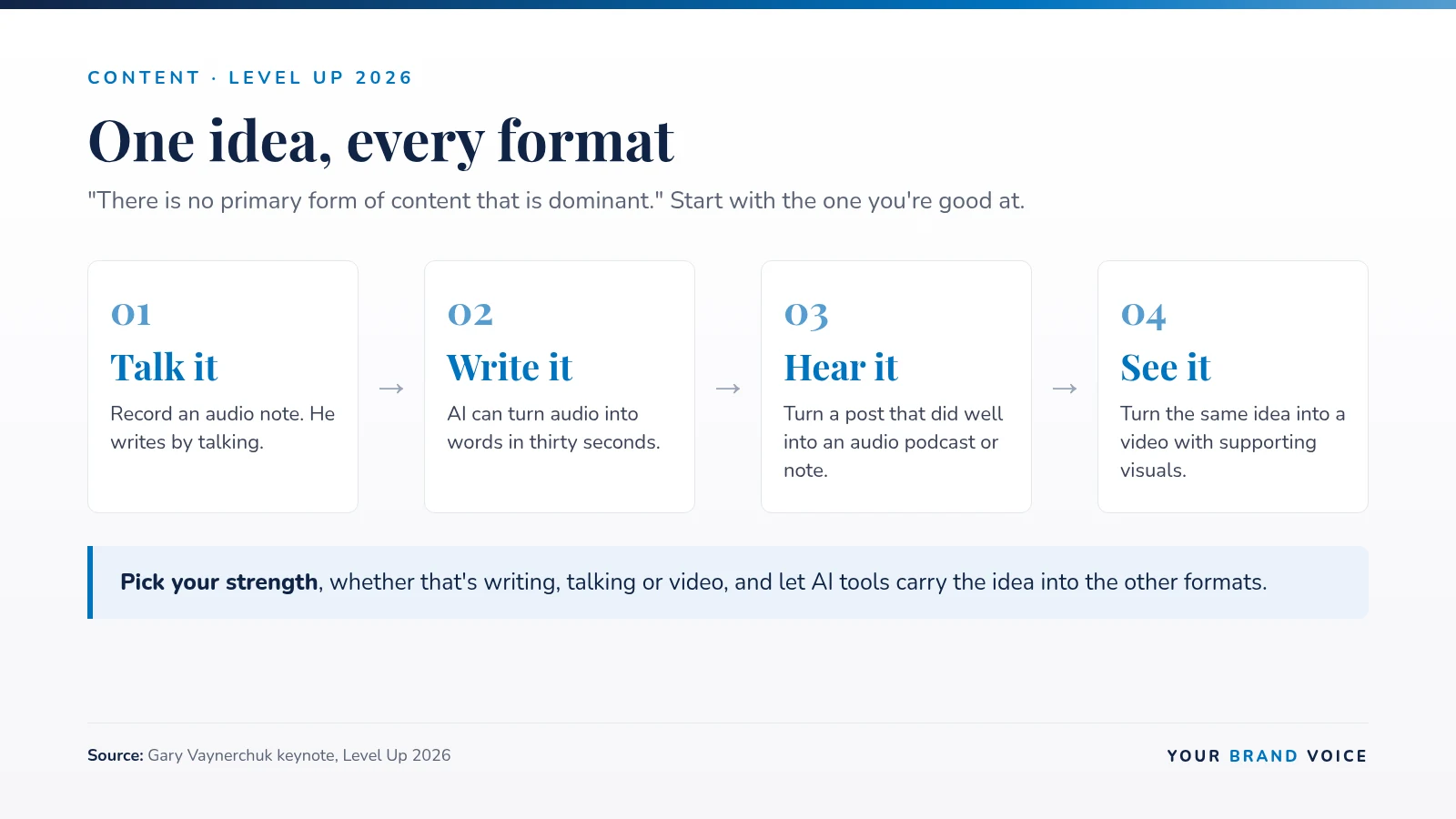
“There is no primary form of content that is dominant,” he said. Video gets the headlines, but if you’re a better writer than you are on camera, write. He called Substack his “favorite platform of underpriced attention right now,” and pushed the writers in the room to look at Substack and Beehiiv and to “get serious about LinkedIn.”
He also shared how he does it. He doesn’t sit down and type. “It’s all me doing audio notes, and then it’s turned into words.” He used to have two full-time writers turn his audio into written posts. “Now, AI can do that in thirty seconds.” When a written post does well, he turns it into an audio version, and then into a video with supporting visuals.
This is how we think about content for our clients, too. A contractor who explains a job well in a two-minute voice memo already has a blog post, an email and a short video inside that memo. The idea is the hard part. AI tools help with the rest, and, as I wrote on Day 1, a person still checks every word before it goes out.
Reach is free, for now
He believes “we are entering the greatest era of merit and opportunity that the world has ever seen,” because “every person, at low costs because of technology advances, can compete with everyone and get everything they want.”
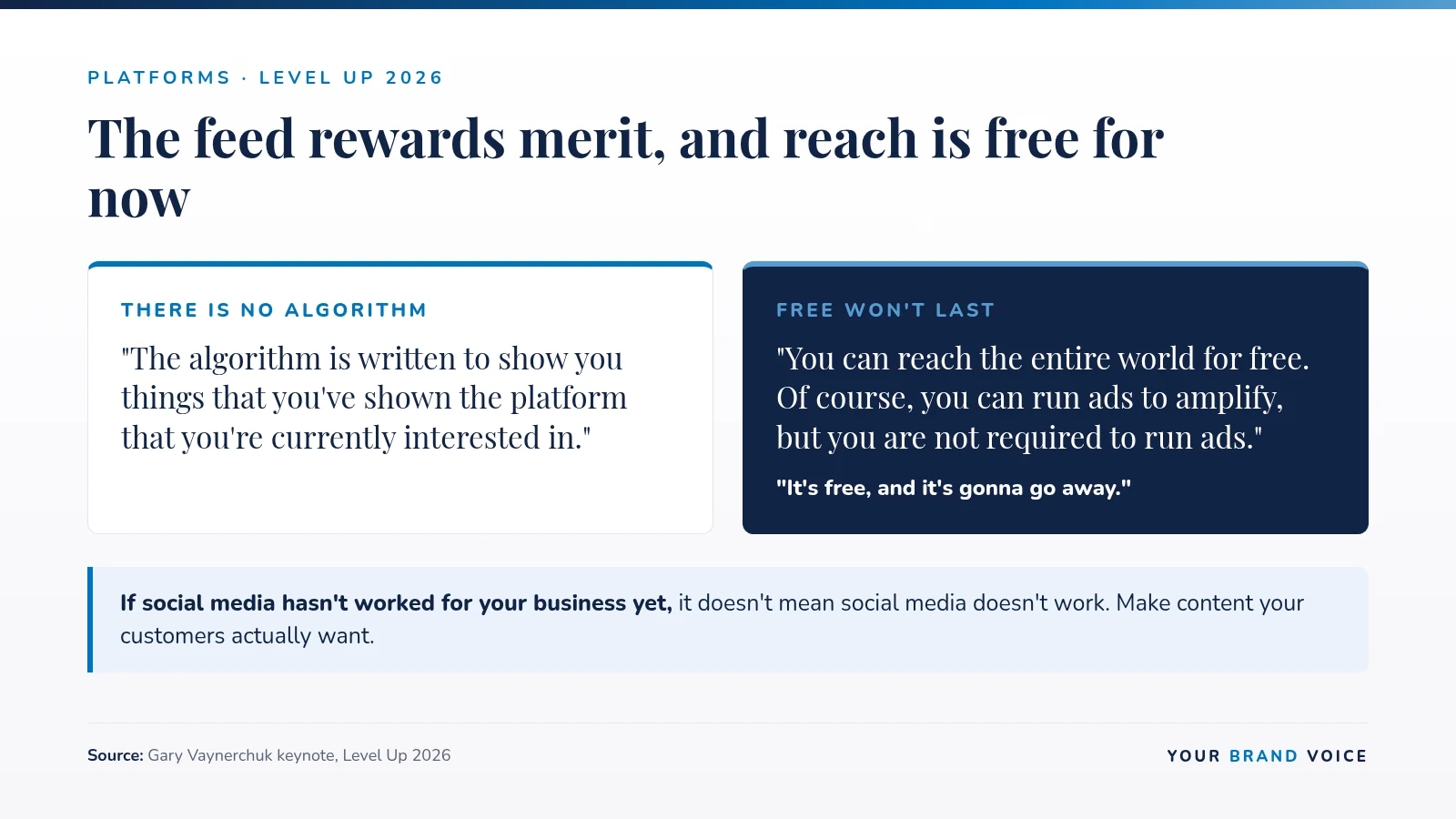
He also took on the most common complaint about social media. “There is no algorithm,” he said. “The algorithm is written to show you things that you’ve shown the platform that you’re currently interested in.” If social media hasn’t worked for your business yet, “it doesn’t mean that social media doesn’t work.” In my experience, it usually means the content isn’t something your customers want to see yet.
And the window won’t stay open forever. “You can reach the entire world for free. Of course, you can run ads to amplify, but you are not required to run ads.” Then the warning: “It’s free, and it’s gonna go away.”
Ads still have a place. Once your posts show you what people respond to, web retargeting keeps your business in front of people who already visited your site, so a good post can turn into a call or a visit.
Put in the hundred hours
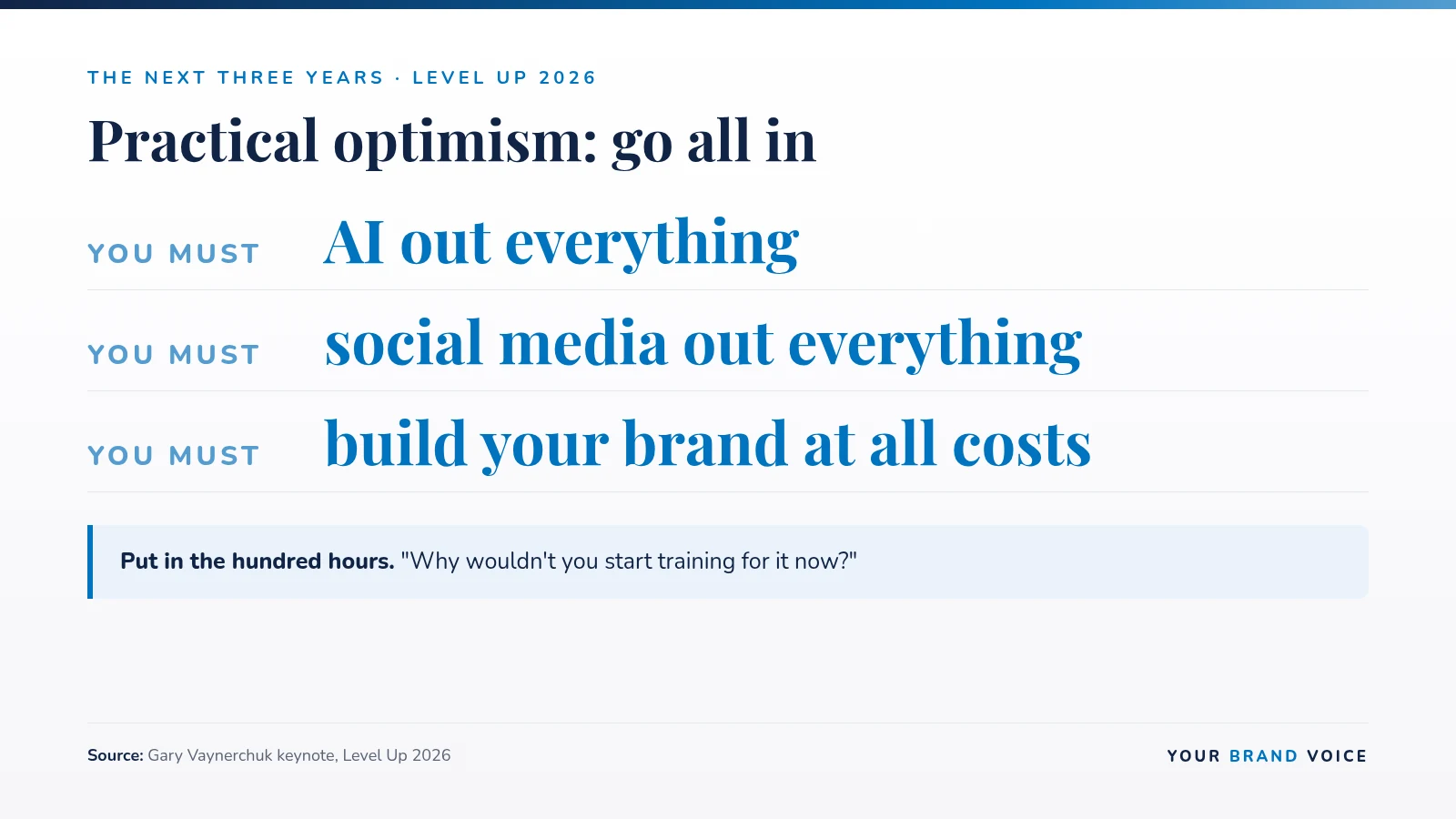
He asked the room who had been avoiding AI, and he didn’t let anyone off the hook. “For yourself, I need you to put in the hundred hours of research.” His warning wasn’t that AI itself will replace your business. “It’s about entrepreneurs that are gonna weaponize AI that are gonna take your business.” The good news, in his words: “you can also weaponize it for you.”
His closing ask was direct: “You must AI out everything. You must social media out everything. You must build your brand at all costs.” He called it practical optimism, and he framed it like a marathon you know is coming: “why wouldn’t you start training for it now?”
Know yourself, and lead with value
Two ideas from early in his talk are worth keeping. The first is self-awareness. “Self-awareness is the most important thing,” he said, and it has to come with humility: “once you get self-awareness and humility down, you can really cook in life.” Know what you’re good at, own what you’re not, and build around it.
The second is value. Even for a simple social post, he asks, “what value could that bring to you?” He called it reverse engineering: “Reverse engineering value is disproportionately the way people build something meaningful.” For a local business, that means every post, email and page should answer one question for the customer: what’s in it for me?
How the three days fit together
Looking back, the three days told one story. Day 1 was about getting found: customers now search everywhere, and AI assistants help pick who to call. Day 2 was about earning attention and trust fast enough that the right customers raise a hand. Day 3 was about what makes any of it last. Search will change, and platforms will change. Your reputation, and how people think of you, goes with you.
Near the end, he said “you’ve never been more empowered because of social media for free and the AI at low costs than you are today.” His last line stayed with me: “If you win in the next decade, it will be on your own two feet.”
A simple checklist
Here is what I’d do this week, based on his talk:
- Write one sentence about how you want customers to think of your business.
- Pick your strongest format: writing, talking or video.
- Record one voice memo answering a question customers ask you, then turn it into a post.
- Turn your best-performing post into a second format: text, audio or video.
- Show up on one more platform where your customers already spend time.
- Block time every week to learn AI tools, and start on your hundred hours.
What this means for your business
If you run a service business that lives on leads, or a local business that lives on foot traffic, your brand is what makes a stranger choose you over the business down the street. Showing up often, with something useful to say, is how you build it. Answering every lead fast is how you keep it.
That’s where we help. As a certified GoHighLevel partner, we set up GoHighLevel onboarding so every inquiry gets a fast reply and every follow-up happens, and we set up HubSpot too. Onboarding is free, and you get 100% support after launch. You can see our pricing any time.
Let’s make your business the one customers remember.
Read the series from the startDay 1: Fewer clicks, more customers →