People will give you their time before they give you their money. Earn the time first.
I’m still in Dallas for HighLevel’s Level Up 2026, and day 2 brought two keynotes that fit together better than I expected. Yesterday I wrote about AI search and getting found.
Today was about what happens after someone finds you: getting noticed, earning trust fast, and making it easy for the right customers to raise a hand. Adley Kinsman spoke on becoming “unignorable” in an AI era, and Ryan Deiss shared three marketing strategies that are working right now. Here is what I’m taking home, and what it means for your customers.
- Earn attention first. Entertain the masses, educate the interested, and sell to the committed.
- Trust takes time, so deliver it in one sitting. Roughly seven hours of content, 11 interactions and four locations to build enough trust to buy, and binging delivers all of it at once.
- Find out who is ready without selling to everyone. A P.S., a re-registration invite or a short handraiser email lets the right customers raise a hand.
Get noticed first: Adley Kinsman on becoming unignorable
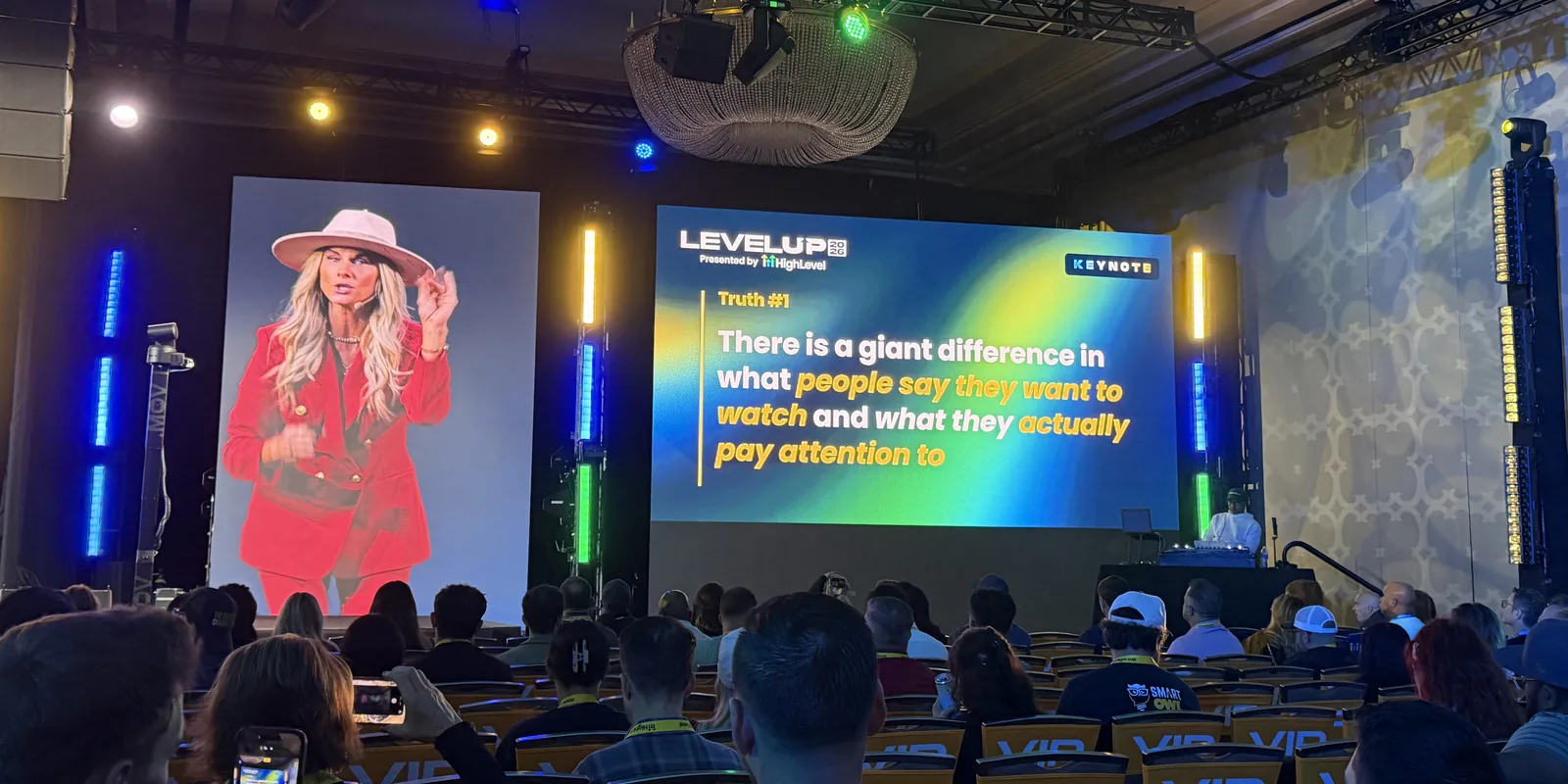
Early on, Adley said something I wrote down right away:
“Every single organic post that you make is a salesperson who works for free.”
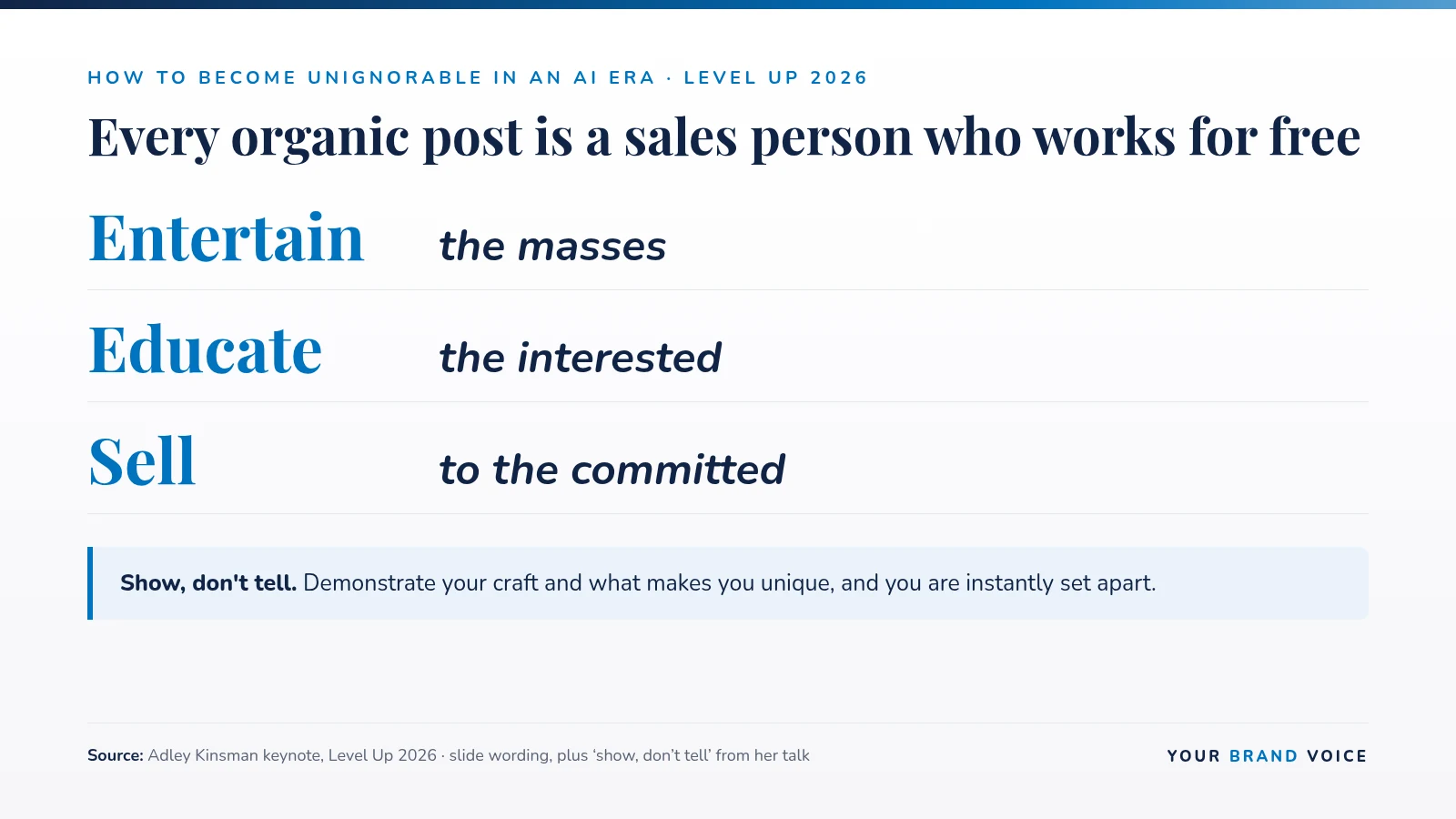
Her framework for the posts themselves is simple: entertain the masses, educate the interested, and sell to the committed.
A few ideas from her session stuck with me:
- Show, don’t tell. “If you can just simply show and demonstrate your craft and the uniqueness about you, show and get out of telling, you are instantly set apart.”
- Run the “duh test” on your hooks. If you could say “duh” after your opening line, rewrite it. Her slide contrasted “Successful people protect their investments” with “This $20 piece of silk could save you over $20,000.” A good hook creates an emotion and a curiosity gap, and she said not to pay off the curiosity until the end of the video.
- Aim high on the first six seconds. Her target is 90% retention in the first six seconds, which she said would put you in the top 1% of content served to the algorithm. Someone she asked told her that 82% is “pretty dang good.”
- Lead with a story only you can tell. She described helping a glassblowing studio turn the owner’s own story into a small series. They led with community through a story nobody else could replicate, and that is how they sold something very niche.
I only captured part of Adley’s session, so this is what I heard rather than her full talk.
Why trust is the whole game

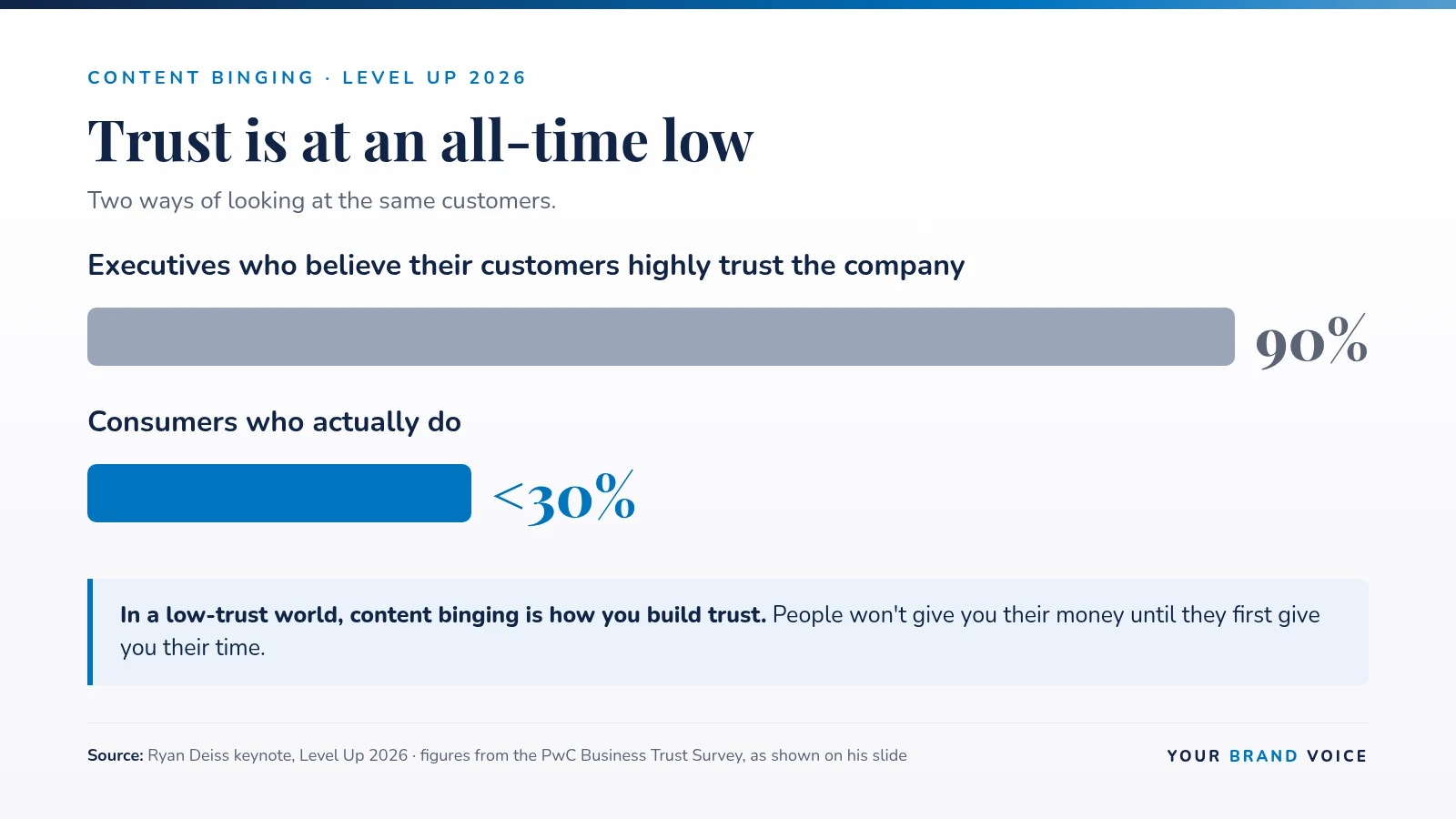
Ryan Deiss started with a blunt slide: “Most of what used to work in marketing just doesn’t work anymore.” His evidence was a trust gap. In the PwC Business Trust Survey figures he showed, 90% of executives believe their customers highly trust their company, while fewer than 30% of consumers actually do.
Three ways to make people binge
His answer is what he calls content binging. “Bingers are buyers.” His slide put it this way: it takes roughly seven hours of content, 11 interactions and four locations to build enough trust to buy, and binging delivers all of it in one sitting. “People won’t first give you their money,” he said. They give you their time first.
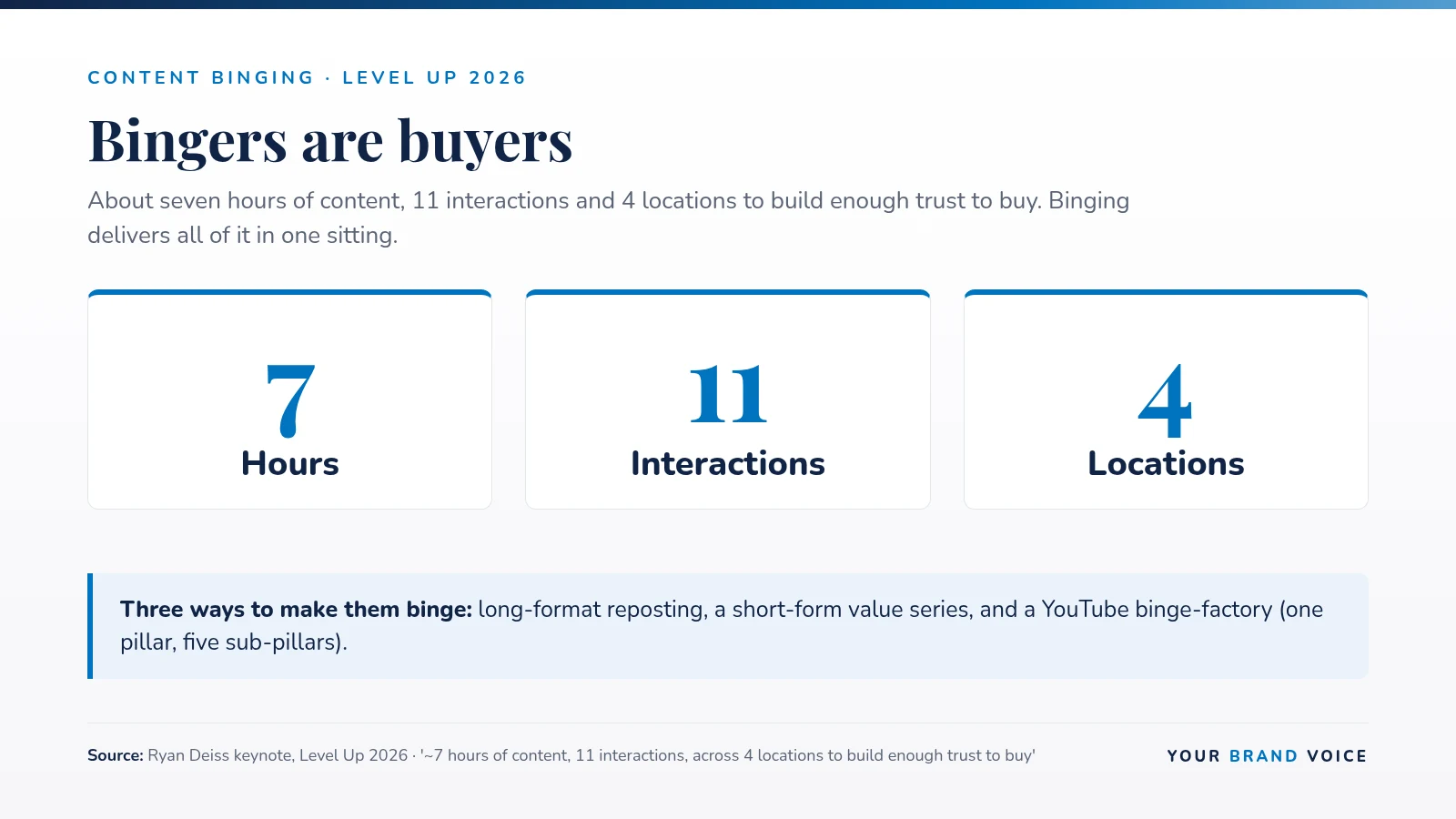
That also means speed. He said the long email drips many of us were taught, 30 days or more, do not work anymore. “The key is speed.” Here are the three ways he showed to make people binge:
- Post long content uncut. Full newsletter articles and long threads, posted natively on X and LinkedIn, not teasers or links back out. His slide credited this with 5 to 7 times the views and engagement of short-form for long posts on X.
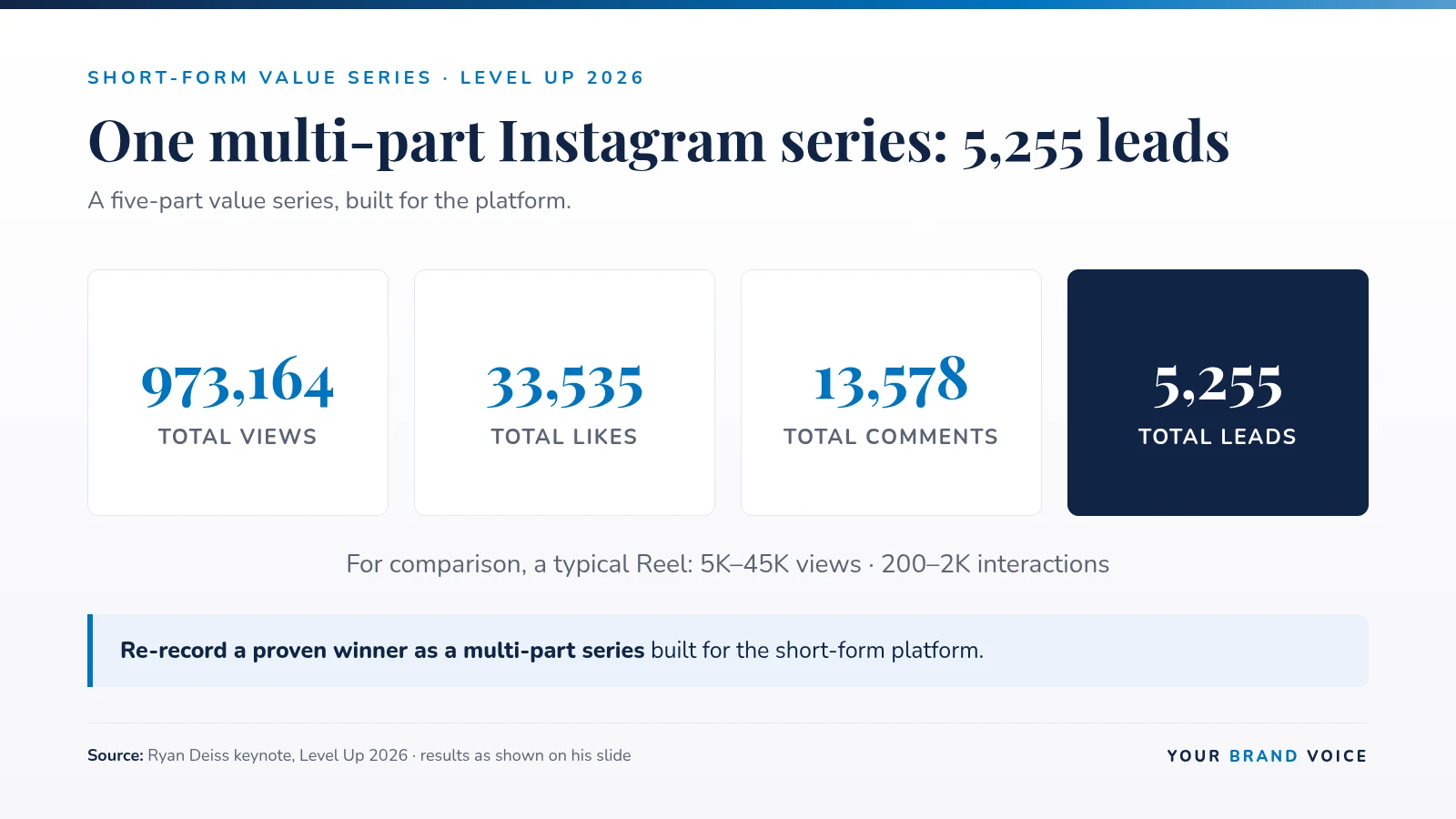
- Turn a proven winner into a short-form series. His five-part Instagram series drew 973,164 views, 33,535 likes, 13,578 comments and 5,255 leads. A typical Reel, per his slide, gets 5K to 45K views.
- Build one pillar, then five sub-pillars. Start with the content you probably already have: your best webinar or training, or the lesson clients always thank you for. Split it into five smaller pieces and link them back.
Sell in private
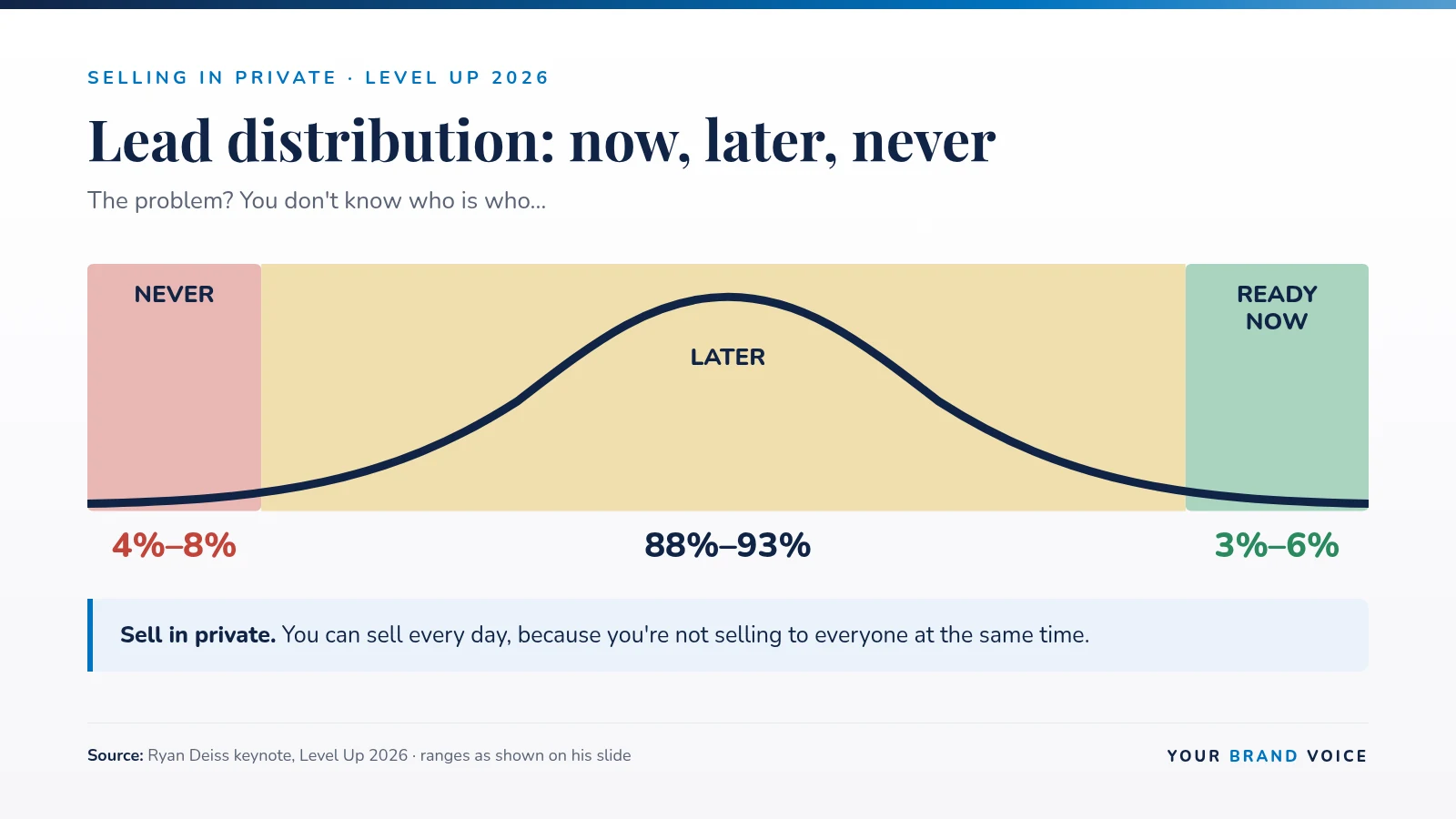
Ryan’s image for this was a popcorn popper, not a funnel. Some kernels pop right away, most need time to heat, some never pop. His lead distribution slide put numbers on it: 3% to 6% of leads are ready now, 88% to 93% are later, and 4% to 8% are never. “The problem? You don’t know who is who.”
He gave three simple ways to find out who is ready, without selling to everyone at once:
- Passive segmentation. Add a P.S. to every email: when you’re ready, here are three ways to work together. Something free, something inexpensive, and your core offer.
- Re-registration. Invite people already on your list to opt in again, with a new guide or a live training. Treat their engagement as a signal of readiness.
- Handraisers. Short, conversational emails that ask for a reply. His slide template is as simple as “Anything I can do to help you move faster?” Whoever replies is ready.
His planning rhythm: one content day, one segmentation campaign per week, and two off or wildcard days, rotating the campaign type each week.
Put a human face on the business
His third trend, in his words:
“Faceless brands are dead.”
Ryan Deiss
He cited a study in which 82% of consumers said they are more likely to trust a company whose leaders are active on social media. Not celebrities, leaders. He pointed to Wine Library, which grew from $3M to $60M with a founder-led voice. He also showed small businesses doing it: a home inspector in Arizona with 606K Instagram followers and a cleaning company with 1.4M likes on TikTok. His throughline slide tied the three trends together: as AI floods the world with infinite “great” content, humanity becomes the scarce resource.
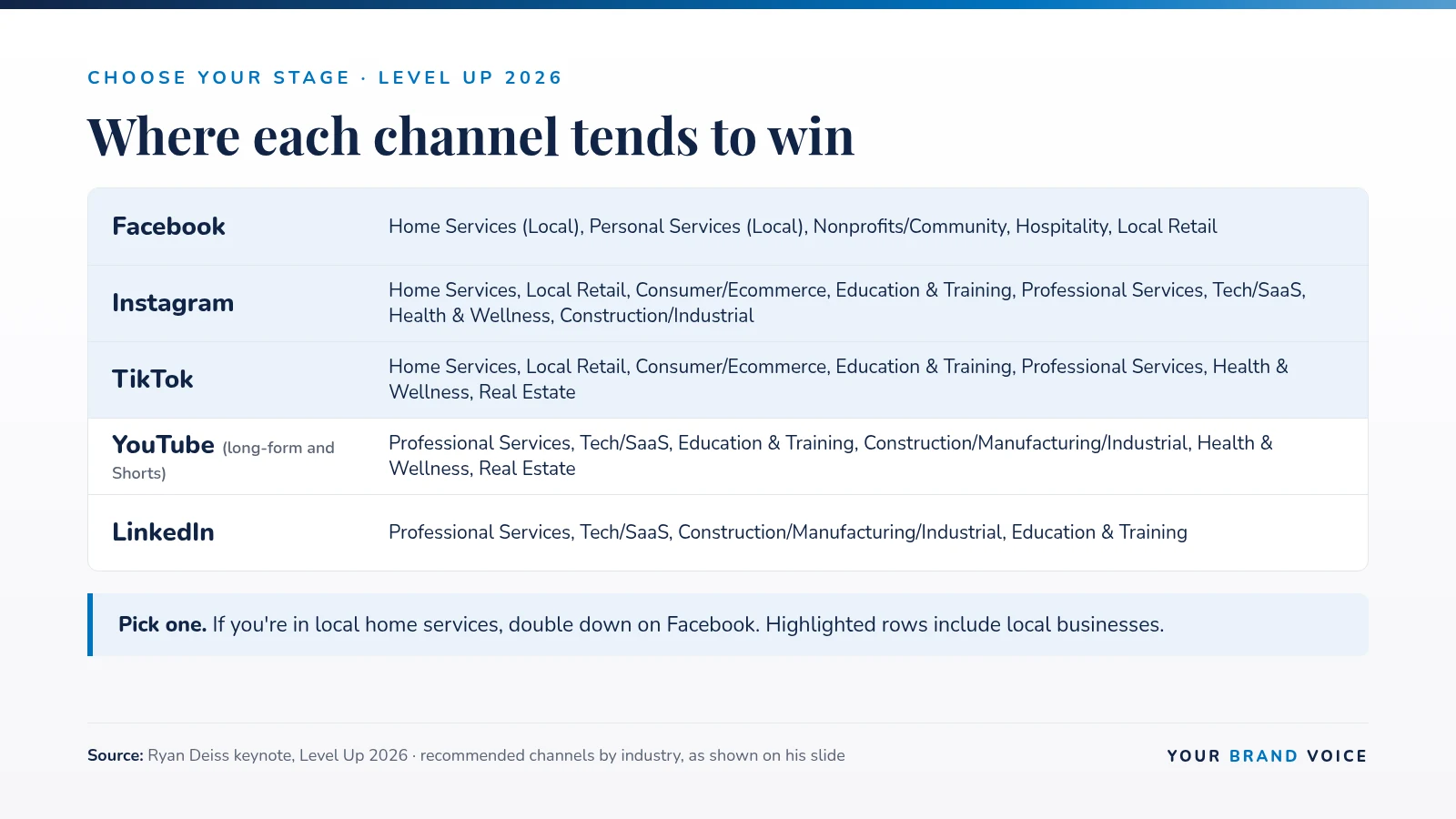
His one play has three steps: choose your character, choose your stage, and integrate the business. Be deliberate, not fake. Pick one platform where your customers already spend time, and point the attention back at the brand: “traffic, not vanity.” One practical note for local businesses: his slide listed Facebook as a channel that tends to win for local home services, local personal services and local retail, and he said local home services should be doubling down there.
A simple checklist
Ryan closed with “three things to run this week.” I’ve added a few from both talks:
- Cross-post one long-form piece into a short-form channel, or build long-form for one.
- Send one handraiser message: a short email that asks for a reply.
- Write down three unique points of view by flipping the conventional beliefs in your industry.
- Add a P.S. with a free, an inexpensive and a core option to every email.
- Run the “duh test” on your next hook.
- Pick one platform where your customers already are.
What this means for your business
If you run a service business that lives on leads, or a local business that lives on foot traffic, the common thread is the same: customers have endless choices, so earn their attention, show up as a real person they can trust, and make it easy to reply. You don’t need a bigger budget. You need a clear, steady rhythm.
That rhythm is where the follow-up is handled for you. As a certified GoHighLevel partner, we set up GoHighLevel onboarding so replies get answered and every follow-up happens, and web retargeting can keep your business in front of people who have already visited. Onboarding is free, and you get 100% support after launch. You can see our pricing any time.
Let’s make sure your business is the one customers choose.
Next in the seriesDay 3: Brand is the moat →